


Full colour decoration consists of full colour transfers, either direct to film or direct to paper and of course direct to garment printing.
Full-colour transfers, also known as digital transfers or heat transfers, are a popular method for decorating merchandise with vibrant, detailed designs. This technique involves printing a design onto special transfer paper using a digital printer and then applying the design to the merchandise using a heat press. Here are some key aspects, advantages, and reasons why people use full-color transfers:
Process of Full-Colour Transfers
Design Creation: The design is created digitally using graphic design software. It can include a wide range of colors, gradients, and intricate details.
Printing the Transfer: The design is printed onto special transfer paper using a high-quality inkjet or laser printer. For certain types of transfers, such as sublimation, special inks are used that convert into gas when heated.
Cutting the Transfer (if necessary): For designs that are not full coverage, a vinyl cutter may be used to trim the excess material around the design.
Applying the Transfer: The printed transfer paper is placed onto the merchandise (e.g., a t-shirt, bag, or other items), and a heat press is used to apply heat and pressure. This process transfers the ink from the paper onto the fabric.
Peeling the Backing: After the heat application, the transfer paper backing is peeled off, leaving the design adhered to the merchandise.
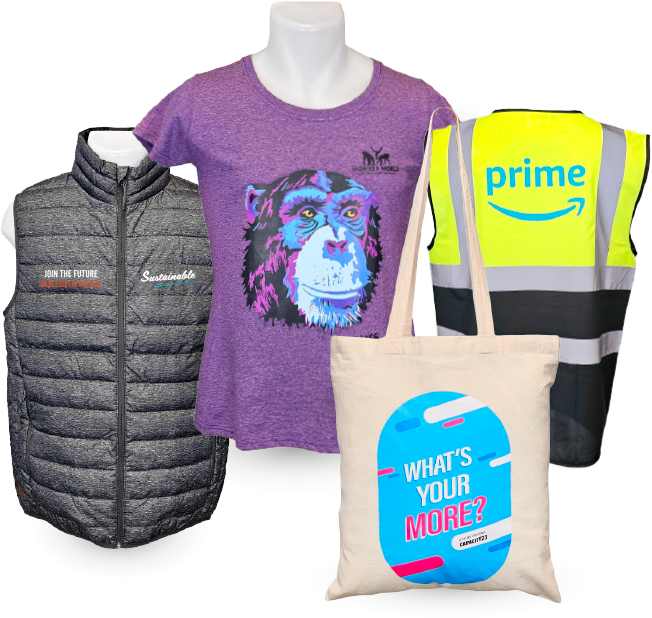
Advantages of Full-Colour Transfers
High Detail and Colour Range: Full-colour transfers can reproduce complex designs, including photographs, with a wide range of colours and fine details that are difficult to achieve with other printing methods.
No Colour Limitations: Unlike screen printing, which requires separate screens for each color, full-colour transfers can handle any number of colours, including gradients and full-colour images, without increasing the cost.
Low Setup Cost: The initial setup cost is lower than screen printing because it does not require creating screens. This makes it economical for short runs and one-off items.
Versatility: This method can be used on a variety of materials and items, including cotton, polyester, blends, and even non-fabric surfaces like ceramic and metal (with the appropriate transfer type).
Quick Turnaround: Full-color transfers allow for rapid production and are ideal for on-demand printing and small batch orders.
Soft Hand Feel: Modern transfer materials can result in a soft, flexible design that integrates well with the fabric, enhancing comfort and wearability.
Common Uses of Full-Colour Transfers
Custom Apparel: T-shirts, hoodies, and other garments with custom designs for events, businesses, and personal use.
Promotional Products: Bags, caps, and other items often use full-colour transfers for vibrant and eye-catching logos and designs.
Personalized Gifts: Items such as mugs, phone cases, and pillows can be decorated with full-colour transfers, making them ideal for personalized gifts.
Sportswear: Jerseys and other sports apparel often feature full-colour transfers for team logos and player names/numbers.
Corporate Merchandise: Full-colour transfers are used for branded merchandise like tote bags, aprons, and lanyards.
Why People Choose Full-Colour Transfers
Transfer printing is a cost-effective method that’s great for even the smallest print runs, or for orders with individual designs or names.
It’s a good option if you need accuracy – for example, for artwork that features lots of intricate detail or small text.
We often recommend transfer printing for items that have an awkward shape, or fabrics with a high plastic content.
- Detailed and Vibrant Designs: Capable of reproducing detailed, high-resolution images and a wide range of colours, making them ideal for complex and colourful designs.
- Cost-Effective for Small Runs: Lower setup costs make this method economical for small quantities and custom, on-demand items.
- Versatility: Suitable for a wide range of materials and products, providing flexibility in merchandise options.
- Fast Production: Quick setup and production times allow for fast turnaround on orders, making it ideal for events and last-minute requests.
- Customizability: Easily customizable, allowing for personalized and unique designs on individual items.
Overall, full-color transfers are valued for their ability to produce high-quality, detailed, and colorful designs quickly and cost-effectively, especially for small quantities and customized items.
WHEN TO USE ANOTHER PROCESS
If you’re ordering a large print run, it may be more cost effective to go with screen or transfer printing instead. DTG works using the CMYK colour model, so it doesn’t print Pantone colours. If you need an exact Pantone match, this may not be the best option for you. And if your design is simple and bold, with solid blocks of spot colour, we’d probably recommend screen printing instead.
Lastly, the print isn’t quite as hardwearing as other methods. This isn’t necessarily a big problem though – we’d recommend turning garments inside out and washing on a cold cycle to help print stay vibrant for longer.
WHY DIRECT TO GARMENT?
With no screens and no lengthy preparation, direct-to-garment printing is easy and speedy. It’s also great if your artwork is very detailed, or features subtle shading and gradients – even photo-realistic artwork can be reproduced beautifully.
The texture of the finished product is another consideration. While screen printing can give a slightly plasticky feel, DTG works by injecting water-based ink straight into the fibres. The resulting texture feels just the same as the unprinted areas of the item.